Friday, March 16, 2018

Winter Term Personality Test


As promised, after Fall term, I said I would take the 16 Personalities test after each term to see how my character was changing.  At the end of Fall term, I was the “Executive”, or ESTJ.  I retook the test, and I’m still an Executive.  However, one thing has changed.  It is the identity piece to the letters.  The identity piece does not affect what personality I am, however, it shows how confident one is in their decisions.  

One is either Turbulent (T) or Assertive (A) for the identity piece.  According to the 16 Personalities test, “this trait underpins all others, showing how confident we are in our abilities and decisions.”  Last term, I was turbulent by 70% and this term I’m assertive by 54%.  I was a bit confused by this at first, so I looked up what this meant.  The turbulent person is one who is prone to stress.  They are very reflective and always strive to do more.  The assertive person is more confident in their actions and less prone to stress.  The assertive believes what’s done is done and cannot be changed.  

While I scored 54% on assertive, I agree that this term I have been striving to manage my stress better.  Throughout the term I’ve been briefly flipping through Dale Carnegie’s How to Stop Worrying and Start Living.  While the results of my test say I’m assertive, I do not think I’m assertive to the degree that I do not strive to improve.  I also do not live with the belief that what is done is done and no further improvements can be made.  So I guess scoring almost in the middle between turbulent and assertive is an accurate measure.  

MY JOURNEY:
ESTJ-T → ESTJ-A


Winter Term

Fall Term


Tuesday, March 13, 2018

Portugal 2018


This past week, I have been vacationing in Lisbon, Portugal.  It is the first time I’ve been to Europe, and it was an excellent way to start my exploration of the continent.  We spent one week in Lisbon, residing in the historical district and exploring other neighborhoods around the capital. It would be very difficult to restate my entire journey (we visited many places!).  However, there were a couple key places that we visited which I will share.

Portugal has lots of palaces and historical buildings.  Having a long and powerful history, it seems almost natural that Portugal would have many palaces built for the royal family.  My family was able to visit four palaces during our stay.  The first two palaces we visited are called Pena Palace and the National Palace.  All the palaces are located in Sintra, which is about 40 minutes from Lisbon by train.  The National Palace was the first palace my family and I visited.  The National Palace has two very large chimneys that lead down to the kitchen.  From the outside, these two chimneys give the palace an unique appearance.  The biggest of the four palaces with perhaps the most brilliant colored exterior was the Pena Palace.  Pena is characterized by the yellow walls on the exterior.  When I was walking on the Moorish Castle, from a distance, Pena Palace looked like it was covered in gold.  The National Palace was all white except for red roofing (typical Portuguese style!).   The Monserrate Palace was very intricately designed.  Its colors were very different from the colors of the other three palaces.  It was orangey and pinkish.  The shape of the main dome also reminded me of the Taj Mahal.  We were able to enter all the palaces as well, and the walls of Monserrate was lavishly decorated with granite.  The Quinta da Regaleira was by far my favorite palace.  Not only was the summer palace itself beautifully and grandly constructed, but it was embedded beneath a garden that’s big enough to be considered a park on a mountain.  My family and I explored the park and there overall it gave off a very mystical and fairytale like vibe.  It was essentially one big mountain with many grottos, castles, walls, and underground tunnels.  What was neat about the garden was that there were many paths.  These paths wove through the mountains and somehow, they were all interconnected.  It was enjoyable to walk up and down through the paths and somehow end up in the same place. 

Pena Palace

Pena Palace


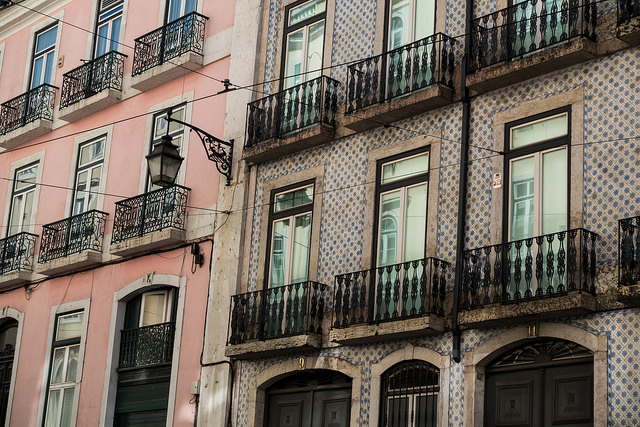
When we weren’t walking through historical buildings or castles, my family spent time in the historical district of Lisbon.  From movies and from books, I knew that European streets and architecture was different from the US.  I knew that Europe had narrow streets and crowded ancient buildings.  While this is true, Lisbon itself is very unique as well.  Portugal uses a lot of tile in the construction of their buildings and roads.  Thus, the roads are colorful, and the color of houses range from yellows to reds to blues to light purples, depending on the color of the tile used.  The sidewalks are also tile.  There are two colored tiles, and they are often arranged into particular patterns.  However, Lisbon also uses red tiles for their roofs.  From a high viewpoint, the city looks terracotta red.  

The food in Portugal was also delicious.  Lisbon is packed with bakeries.  Having never seen so many pastery shops in my life, I was eager to try as many different cafes and bakery shops as I could.  And yes, I’m not exaggerating when I say there are patisserie shops on every street in Lisbon.  The main streets, or large streets often had a patisserie shop every five to seven stores.  The most popular, must-try food in portugal is called a Pastel de Nata.  In plain English, a Pastel de Nata is a flaky, crispy, crust filled with the perfect ratio of custard filling.  Adding sugar and cinnamon is common.  Pastel de Nata are sold at every bakery.  I’m not kidding.  At all.  On the day I arrived in Lisbon and was walking through the streets, I was looking through the windows of the patisserie shops and was confused when I saw burnt looking little tarts that somewhat resembled fruit tarts.  However, the second day, when I went on a walking tour with the hotel, our tour guide told us the prominence of the Pastel de Nata in a typical Portuguese diet.  In fact, he took us to the cafe that supposedly has Lisbon’s best Nata’s.  This is also the cafe where a famous author (whose name I’m blanking on), sat for hours every day but ordered the same thing every day: a cup of coffee and one Nata.  Local people sit in cafes and enjoy a similar combination in the afternoons.  

Europe in general is more environmentally conscious than the US on average.  I was able to experience this hands-on during my trip.  It was astounding to me how obvious the effort to preserve the planet was.  Perhaps it was not as obvious to another person who was from another European country, but to me, from the US, it was quite clear beginning with the size of cars.  Every Ubur my family took was not only small in comparison to cars in the US, but the cars are also narrower!  In addition, station wagons and hatchbacks were typical…SUVs were a rarity.  Food portions in Portugal are also much smaller.  My family rarely wasted food, since we were able to finish the portions given.  I believe I used one paper cup my entire stay.  Cafes serve coffee in porcelain cups and I rarely saw a paper cup in the trash barrels.  

It rained 5 out of 7 days.  Luckily the last two days of our trip were sunny.  The rain was only periodic, so I was still able to enjoy the city with my family.  This trip was quite insightful on the environmental side.  I became more aware of the various ways another country helps preserve the Earth.  I was also forced to communicate with people who didn’t speak English perfectly, or even at all, while also picking up a little bit of Portuguese through menus and store names.  It was a wonderful trip.


IMAGES

Street at Night, Lisbon

Quinta da Regaleira

Quinta da Regaleira

View of the city

Monserrate Palace

Lisbon view, red rooftops 
Tile buildings


Holy Cross + Golden Gate Bridge replicas in Portugal


Saturday, March 3, 2018

ART311: Lessons Learned and my projects


Winter term of 2018 has officially ended.  I am happily on break.  My hardest course this term was most definitely the product-design course I took.  Art311 was a major time commitment, but there are a couple things I learned from taking just this one course.  There were the concrete programs that I learned, such as Adobe Illustrator and Rhinoceros.  However, something I admire most about this class was my teacher’s effort to run the class as “real-world” as possible, meaning he tried to imitate a workspace environment, similar to that of his architecture firm.  The following is perhaps a memorandum.

  1. Making things takes times.  I know in some classes, I can get away with forgetting to do a reading one night, or forgetting to do a problem on a math assignment and still manage to succeed.  Something Mr. Lawson really emphasized in this class is that designing and making things takes time.  While in certain high school classes it is possible to get away with dropping certain assignments and work, in Mr. Lawson’s product-design course, it was virtually impossible to get away with spending minimal time.  To create a product, a lot of time outside of class had to be spent.  There was simply no getting around this.  This forced all of my classmates and me to truly dedicate ourselves to the process.
  2. There will be lots of drafts/redos and that’s okay.  All four project I made had to be redesigned at least three times, whether that be physically printing things, or redesigning products on Rhino.  I remember for my first project I was designing a pencil holder.  Since I was just being introduced to Rhino, I was still unfamiliar with the various tools.  Thus, I ended up redesigning my pencil holder at least four times, before finally laser cutting the pieces out for assemblage.  This happened with my tea tray as well as my final lantern (pics below).
  3. The power of self problem solving.  My teacher believes in self-problem-solving.  In the real world, my teacher mentions how there will not be someone who will guide us through every step like teachers in grade school do.  In fact, this may be one of the biggest flaws in the educational system: when a teacher tells their students exactly what to do and offers the student no freedom in trying out their own ideas with trial and error.  Mr. Lawson says that in the real world, we must rely upon ourselves to figure out problems, not follow a strict guideline of one person.  Thus, in Art311, Mr. Lawson challenged us as students to find our own flaws in design and to find ways to work around them by ourselves with minimal guidance from an experienced person.  

This term, I spent approximately 1 hour per night on my various art projects, whether that be designing on Rhino, 3D printing, laser cutting, or assembling my pieces.  It was a very time consuming class, but reflecting back today, I wouldn’t take back one minute of it.  

PROJECTS
First draft of lantern

Final draft of lantern (altered the shades)

Final draft of pencil holder

First draft of tea tray
 
Revised draft of tea tray

Sunday, February 25, 2018

The possibilities are limitless


One of the things about Andover is that the limits are endless…and it stays that way. 

Coming to Andover, I planned on joining the newspaper, join a business club, practice piano, and play sports.  While I have done what I’d planned on doing, I’ve found there is so much more to do.  In fact, I’m far from content with what I could do.  Yes, I’ve started a business club, but I’m trying to find ways to expand it.  Yes, I write for the Commentary section of the Phillipian.  But I’d also like to start writing for News in the Spring, and perhaps start Phillipian photo next fall.  I’m also beginning to engage in some affinity groups.  There are so many things to join and try. 

The upperclassmen tell me to try as many things as possible as a freshman, since my homework is still at a manageable level.  This way, I can find what I’m truly interested in my later years, and focus in on those.  What’s really wonderful is how willing people are to help new members get involved in a club or an organization.  For me, I emailed the editor of the News section and she immediately offered to help me get involved in the spring. It occurred to me early today that this is partially what makes the possibilities limitless.  It’s the inclusiveness of the school on a whole.  

Saturday, February 24, 2018

Our lives back home influence our lives here


One of the beautiful things about Andover is the diversity.  People come from all of the world, with different backgrounds, household cultures, political beliefs, religions etc.  Last night, I was walking back to my room when I heard some of my friends talking about this.  I tuned into the conversation. 

At Andover, all backgrounds are welcome to be expressed.  I notice how people’s backgrounds influence how they perceive different manners.  For example, I have one friend who gets takeout to her dorm almost every night for dinner.  I have never gotten takeout in my 6 months at Andover.  I eat at Commons every night, and I feel like I’ve never had more time than that to eat.  I was curious so I was talked to her about this habit, and she told me that she ate out for lunch every day back in China, so eating out is very normal and for her.  

Some people's lives back home are expressed very obviously, while others are less obvious.  I, for one, am an only child.  Coming to Andover, I learned about some of the connotations that only children have.  And while I never speak about how I’m an only child, in English class, in FIT, and when I’m having random conversations, people sometimes ask me, “Are you an only-child?”  When I say yes, they reply, “That’s what I thought.”  For a while, that confused me.  

Last night I realized why through the conversation with my friends.  I believe it’s because our stories show, regardless of whether we want them to or not.  It’s the way we’ve been raised, and we see it as a norm.  Our day to day behavior and demeanor reflects how we've been raised our lives back home.  Our lives back home influence our lives here. That being said, I think all students who come to Andover learn at least one thing, the importance in recognizing peoples various backgrounds and celebrating the differences.  

Sunday, February 18, 2018

Perfectionism + Efficiency

The end of my second term at Andover is coming to a close.  Next week will be our final week of classes, followed by finals, then Spring break.  Since I’ve come to Andover, particularly during this term, I found that I was forced to change my work habits.  

In middle school, I was a perfectionist.  I’d say I was never of the extreme type of perfectionist, but I was concerned about the details enough to take at least half an hour longer on most homework assignments than most of my classmates.  For example, I’d write a paper a week before it was due, and then edit it a little everyday.  The day before I had to submit it, I would read it over and over and over repeatedly.  For math homework, I’d be very detail oriented about the neatness, and organization of my work.  While this method did pay back, I ended up being very stressed over spending a lot of time on every assignment.  

I find myself adapting the way I work.  Efficiency is key.  Logistically, I could potentially spend six hours on homework, given that each subject assigns one hour of homework. However, almost no one spends six hours a day on homework (it’s simply not possible since sports end at the earliest 5, and I have lights out at 11).  I’m still detail oriented, just in a different way.  I pay attention to different chunks of a paper that I know are not clear, or I reread certain sections of my math textbook that I know I’m not familiar with, instead of rereading everything ten times.  In math, instead of making my paper look nice, I focus more on seeing if I can solve the problem again in my head. 

So yes, while I’m still a bit of a perfectionist, I’m also becoming more efficient and I hope this will pay off as my major assignments approach their due dates.  


Friday, February 16, 2018

Anyway and Homo Deus

My advisor sent me this quote earlier this week.  I had heard of this quote during middle school, but I'd forgotten about it over the years.  It was very relevant during this past week and kept me motivated, sane, and forgiving of myself.


This second quote I found on the walls of the library.  I found it to be astonishing true.  At a first glance, I saw it as a blur of random ideas strung together with big words.  Then I stopped to deeply consider the quote. I believe it means that we define "success" and "satisfaction" as meeting the goals we hope to meet, or essentially reaching the bar we've set for ourselves.  However, this quote also says that as we continue to reach bars and meet expectations, the bars and expectations are raised higher and higher.  This is when people are forced to stretch.  Going along with how I've interpreted this quote, I would think that I've been stretching a lot these past few weeks. 


Friday, February 9, 2018

The External-caused stress

I think there are two types of stress I experience.  The one I experience more frequently is when I don't perform well on a test and I begin to panic about my grades.  Or when I say something I didn't mean to say to a friend, and I can't stop thinking about how to make it up to them.  Or when I have a lot of stuff on my list to do that I end up freaking myself out because I'm afraid I can't get everything done. 

The stress I experienced this past week has been a different kind of stress.  It's the kind where I'm not the one in control.  In the other examples, it was my fault, my duty, or my responsibility that I failed to meet.  The type of stress I felt this week, or probably more realistically these past two days, have been out of my control.  They have been what I'm now calling external-caused stress.  Many things I was stressed about where out of my control.  For example, I did all the work on my art class and created a product, but someone else simply did a better job than me in creating a different version of a similar product.  This stressed me out in the sense that I wanted to be as good as they were, even though I had completed the work.  And then yesterday, some people said some things that wasn't worded in the most diplomatic way that caused me some anxiety.

I have yet to identify more areas of stress.  But as for external-caused stress, I'm striving to manage it better by realizing that I'm doing my best.  I can't control what other people do or say to me either, nor can I control what other people think of me.  I think external-caused stress may be me over stressing about things I do not need to think about.  I'm going to try to remember that this upcoming week.


Tuesday, February 6, 2018

Home

Home is sacred now.  I want to keep it that way.  When I first came to boarding school in September, I loved the freedom.  I enjoyed the late night, the complete making of my own lifestyle, and the settling in of my own habits.  That all shone very brightly at the beginning of my time here.  I think it may have eclipsed the lack of personal discretion in some ways as well.

I’ve been missing home for some time now.  This past weekend, we had our midwinter holiday, and I was able to return home.  However, I returned to campus early on Sunday (Even though we had Monday off) to work on my art project.  I miss home.  And every time break is around the corner, I long for home.

I miss being able to sleep whenever I wanted.  Sure, I was never one who slept after midnight, but I do not  have someone check lights at 11 PM.  I feel as if I spend less time doing the same amount of work at home, because there are no distractions.  I miss my neighborhood as well.  I have lived in the same place my entire life, so I know the area really well.  On Saturday. I went on a 5 mile run, which I struggle to do at school due to my lack of familiarity with the area off campus. 

It’s the small differences that make home home, and school school.  At home, I am able to shower and then dress in the bathroom that the steam from my shower has heated up.  At school, I have to walk back to my room from the bathroom, and it gets really chilly in the hallways.  Nevertheless, it could be so much worse, so I’m grateful for what I have.  

Home is becoming more prominently home in my head.  I’m seeing it more as a separate comfortable space.  I try to leave the stress for school, and try to bring only a desire for relaxation home (along with a little homework).  But home, I will return to it again in 24 days.  


Saturday, February 3, 2018

Friendships are formed through struggle

The art course I’m taking right now is very difficult.  There’s a lot of homework and time spent on each project.  Mistakes are easily made and a restart is often required.  The thing I’ve noticed though is that the people in my class have bonded in a way that I haven’t bonded with kids in my other classes.  Yes, I’m friends with people in all my classes, but I have a different sort of connection with the people in my art class.  Perhaps it’s because everyone, except for one other girl, is an upperclassman.  But my guess is that it’s because we’ve bonded through the struggle.  

I’m finding that the most genuine friendships are formed through classes where everyone struggles.  We end up bonding through the struggle together.  Last week, my teacher asked that we all finished our products.  People in my class were spending hours in the computer lab working on Sunday, and yet, none of us finished by the deadline.  We talk amongst ourselves about how to make certain products, we helped each other print/laser cut things, and we also talk about how many times we had to restart the project.  It’s an oddly supportive feeling when I tell my teacher I have to start over, but other people join me in saying they need to start over as well.  That’s when I feel I’m not the only person who has messed up.  I’m not the only person who needs to start over.  I think the truest friends one forms are through struggles.  It’s a time where we are forced to reach out and assist one another, rather than just admire each other’s individual success.  In this art class, I’m realizing how we succeed together.