Sunday, February 3, 2019

The side we don't see

Once we get a certain age, I’ve noticed there are things we do not tell people about ourselves. I would suspect that each and every one of my peers at school has stories and hidden talents that no one on campus knows about. I remember in elementary school, it felt as if everyone knew everything about everyone. Oh yes, this person did this over the summer, met this person, had Christmas dinner with this person, this person accidentally spilled chocolate milk on his shirt etc. Elementary school seemed to be those years where we seemed to share everything about ourselves and about our families to all our classmates. People didn’t bother as much with the details; most people were too preoccupied sharing their own stories to listen to others. 

As I’ve gotten older, I’ve noticed how more and more people I’m friends with have secret talents, secrets, and niches to their personalities that I had only found out recently. For example, one of my friends in my French class has already done two triathlons…and when I sit there in class, I never knew that about him! Or my other friend in my fitness class who runs an energy drink business with his brother. I had dinner with one of my closest friends at school last night, and she told me that she’d published a research paper last summer. When I heard this, it blew my mind. One of my closest friends had done research and published a paper in physics! What’s mutual about these examples I’ve mentioned is that their hidden aspects of people I would have never recognized at a first glance, or even after being friends with them for a while (over a year), only now have I found out about their inner selves, the people they are outside of academics, or off campus. 


There’s this adage: people are not how they appear to be on the outside. I suppose for a while I never believed that saying, maybe because I was still young. When I was younger, I believed everyone would tell me everything. But as I’m beginning to experience now, most people I’m going to meet are truly very interesting people. Most have stories and histories few people know about because people chose to keep it hidden. That’s something I didn’t pick up before. And the amazing thing is: if I just stop and open my ears, I’ll probably learn something interesting. 


Sunday, January 27, 2019

A Post of Thanks

This week I struggled for several different reasons. It was a week where everything felt a little out of control. I had many late nights and I woke up early during most days. It was a week where my club felt like it was sprinting a neverending marathon and internal problems skewed the way we worked together this week. I cried a lot this week and I’m not going to try to hide it. I couple weeks ago, I wrote a similar post that I also titled “A Post of Thanks”. I resolved to write more of these types of posts. This week couldn’t have been a better time. 

Thank you to CX, my best friend. She is absolutely amazing, supporting me every day of the week. She was my go-to person to talk to, I knew she’d always offer me emotional support and advice on how to tackle problems. She checked in with me constantly about my days and who it went. I could tell no one else honestly, and she always listened, extending herself out into my shoes. She reminded me ceaselessly to keep calm, and when things got out of control, she'd put her hand on my shoulder to calm me down. To a friend who truly cares and listens and supports, thank you thank you thank you.

Thank you to my English teacher for talking with me and letting me confide in an adult on campus. She offered to help me right away. She came into our conversation with an open heart and she soaked in what I told her. She came out of our conversation wanting to take immediate action. 

Thank you to my advisor from freshman year. I’ve written about her before, and she’s the woman I turn to for pep talks and for advice. She comes in with a sense and a plan, and she is a go-getter in solving problems. I love her tenacity in seeing through barriers that I couldn’t fathom overcoming, and her calm and collected outlook. Thank you for the pep talks and your belief that yes, I can. 

Thank you to my math teacher, who checks in with me regularly. He seems to relate, as he graduated from college recently. He understands what’s troubling me, and he told me that it will happen for probably the rest of my life. He is teaching me to fight my own battles, preparing me for the future. 

And thank you to my parents, who have stayed up late at night to answer my phone calls. Who've supported my decisions with rationale and who've kept me calm. Talking to my parents is one of the greatest things I do, and is something I should be doing more of. Thank you to the two people who've supported me with astonishing consistency and endless love. Thank you.


This has not been an easy week. What struck me about this week, was that it wasn't the academics that was giving me the most stress: it was my emotions. I struggled to believe in myself and to recognize my own self-worth. I was beaten down a lot this week, but thanks to all these people and to those beyond this post, I think I’ve found some footing that I can grow upon. 


Saturday, January 19, 2019

It was the brave souls who raised their hands: inspiration from a talk by Julie Lythcott-Haims

My school brings a variety of speakers over to campus throughout the school year and yesterday I attended “Real American” by Julie Lythcott-Haims. Lythcott-Haims attended Stanford University and Harvard Law School, and later became the Dean of Freshmen and Undergraduate Advising at Stanford University. She wrote a memoir called Real American about her experience being a biracial woman. She read sections of this memoir, written in poetic form during her speech. Her speech was charged with mixed emotions that I’m sure touched each audience member differently. For me, there were many parts of her speech that I did relate to, and there were some parts that I did not connect with as much. Another point that I want to mention that really stuck out to me is when Lythcott-Haims described her experience in life. She mentions that most people think of a story as resembling an A shape, with a climax at some point in the story. Lythcott-Haims describes her story as having a V shape, with the vertex being the point in her life she has labeled “self-loathing”. Her story is forever continuing, but what I like about the V metaphor is that her story does not have a climax.  

The first story that Lythcott-Haims shared from Real American was when she was accepted to Stanford her senior year. At this point in her life on the V, she describes it as the point of decline. In high school, Lythcott-Haims was one of the few students of color, but this didn’t stop her from becoming the president of the student council. This is also the point in her life where she recognizes that she’s not the same as the other kids in her school: she’s biracial, but she identifies as black. After LH is accepted to Stanford, she finds herself in an awkward situation one day after school when another boy who also applied to Stanford is rejected. This boy’s father confronts LH and spits anger charged words at her: my son had higher test scores than you and equally good grades. The only reason you got into Stanford is because you’re black. Those anger charged words hit me during the speech. For LH, this must’ve been devastating to hear as a young woman who had just worked her way into one of the best universities in our country.  The angry father was linking LH’s acceptance to Stanford to the fact that she was black, and in a way, I’ve experienced some similar biases being an Asian woman. When I was younger people linked my grades to the fact that I was Asian, not to the fact that I have to work equally hard to get them. 

The second story that Lythott-Haims shared was about her experience at Stanford. She struggled in her first year to find herself at the university. She said at Stanford, she has never once raised her hand in a class. She lacked the self-confidence to do so and she didn’t want to draw attention to herself. If I remember correctly, this was one of the lowest points in her life. Lythcott-Haims said she loathed herself in this period of her life. I could not relate to her, I’ve never felt a moment in my life where I can describe myself as loathing myself. I suppose one of the reasons why I, a woman who’s almost 40 years younger than LH have not felt such a self-deprecating emotion for a prolonged period of time is because of the work of the people before me who’ve fought for that equality so that my generation can feel safer belonging in America. Thank you. 

The final part of Lythcott-Haims’s speech touched my heart so much. It felt like every word she said was being soaked into my ears and that my neck was straining forward as if that would help me hear better. What I enjoyed the most about her speech was when she gave the example with God. Lythcott-Haims believes that before we are all born, God speaks to all of our souls and he asks us: who wants to go down to Earth as a person of color? Though there will be times of struggle and dispute, who wants to go down there, drive change, and bring a sense of equality to mankind? Then LH said something that I will probably remember for the rest of my life: it was the brave souls who raised their hands. I’m not religious, but this sentence didn’t in the very least fail to stick with me. 


Julie Lythcott-Haims’s speech wasn’t just a call to action…for me, it was a call to awareness. To be aware of stereotypes, of biases, to be aware of my own prejudices towards other people and even towards myself. When do I form these implicit biases about others? When do I allow stereotypes applicable to me to affect my actions. Julie Lythcott-Haims’s speech spoke to me in ways that other speeches about activism have not. It was relatable to me, even though I was not the same race as Lythcott-Haims and I am truly moved by each and every word from Lythcott-Haims’s speech. 


Sunday, January 13, 2019

10,000 ways that won't work

"I have not failed. I've just found 10,000 ways that won't work" -Thomas A. Edison

I little dose of optimism for this upcoming week of studying for midterms ☺

Sunday, January 6, 2019

My Idea of a perfect day

I returned to campus after Winter Break this Thursday.  After every break, my friends and I catch up with each other. Some of my friends traveled, but I learned that most of them stayed at home. I too stayed at home. Frankly, I felt like I hadn’t “done much” over break; maybe the fact that I stayed at home made me feel so. Perhaps I expressed this feeling of discontent in our discussion as one of my friends asked me, what would you do in a perfect day? 

Off the top of my head, I would say that a perfect day encompasses waking up in the morning and going for a morning hike then relaxing with a cup of hot chocolate and a good book. A relaxing and carefree day seems perfect to me. However, these past three weeks have led me to believe there are several kinds of “perfect” days. This winter break, I may not have experienced the perfect “relaxation” beach day, but I did experience another type of day that was, in its own right, pretty perfect as well. 

Yesterday, simulated a pretty typical day during break. I started my day off with a two-hour study session on Saturday. I completed some of my homework which was followed by a walk to Whole Foods with two of my closest friends. We did some grocery shopping, picked up drinks at a cafe, and returned to campus. I had my lunch after that, studied for another hour, and then headed to the gym. After the gym, I finished my physics homework and began to do some math homework/review. Having finished my homework for the weekend, I began preparing for some tests I’m going to take outside of school. At 10:00 PM, having felt pretty accomplished and productive, so I decided to go to the casual dance in the den on campus. I returned after an hour, took a shower, and called it a night. I would say yesterday made me very happy, even though I did not find myself relaxing on a beach.


What I overlooked this break was how a perfect day was really any day that made me feel happy. On one hand, I definitely enjoy those days at the beach where I do just about nothing except read and go for a swim. Those days definitely make me smile when I think about them. On the other hand, I felt happy coming out of winter break as well. I would wake up, study for a bit, read, go out for lunch, get some exercise in, do some more studying, watch a movie, and talk with my parents; being productive truly made me very happy. What would you do in a perfect day? Sure, by default I might say relax at a beach, do some shopping, go for a hike, or read a good book, but recently, I’ve experienced that a productive day can be just as perfect as a relaxing one. 


Wednesday, January 2, 2019

Farewell 2018; cheers 2019

Happy New Year! (I know I’m writing this a day late). Last year I wrote a wrap up of the year post, and I thought that was a lovely way to conclude the previous and welcome the commencement of the new. I will do something pretty similar this year. 

Speaking honestly, I must say 2017 was the year in my life where everything seemed to work out the way I wanted it to. It was one of those years that spoiled me enough to make me believe that every precedent year would feel similarly and in reality. Little did I know what was to come in 2018. In retrospection, the most difficult part of 2018 was managing my emotions and remaining persistent with my goals. 

Some years pass and it feels short. Others pass and it feels like everything went right (2017 for me). Some pass and I walk out feeling ambivalent, nothing shocking enough to remember (I’d say any year before the age of 7 for me). I think 2018 was none of those types of years. 2018 was a roller coaster of emotions, of constant up and downs. I remember crying myself to sleep many times, screaming at my parents for something that I was solely responsible for, and for letting my emotions affect my disposition for far longer than they deserved. Nevertheless, I’ve discovered that it’s during these types of years that I learn and grow the most. I will never forget what my advisor from my freshman year told me: life is a rollercoaster. There will be highs and lows but what’s important to remember is that when I’m at a low, to remember that it will get better. And likewise, when I’m at a high, to prepare myself for a low and once again, to remind myself that it will be okay. I suppose this is one of the ultimate realizations in life: that it won’t always be a breeze. 

2018 was the year where I learned the true meaning of friendship. 

It was the year where I rediscovered my love for fiction novels. (Some favorites…Educated, Where the Crawdads Sing, The Great Alone).

It was the year where I learned about gratitude and the power of giving back.

It was the year where I discovered how true happiness manifests. 


I’m not upset about 2018 even though I was deeply troubled, insecure, and sad at certain lows throughout the year. Honestly, I’m grateful it happened because I’ve come out of the year stronger than when I approached it. I feel as if I have a game plan now for tackling setbacks and low points and I’m hopeful that 2018 has prepared me well for this year. Cheers to 2019.


Sunday, December 30, 2018

Pachinko by Min Jin Lee

Another review! (I’ve been doing quite some reading this break:)) I read Pachinko by Min Jin Lee this past week. This book has been very highly acclaimed in bookstores and on Amazon. I’m going to admit: I’ve been wanting to read this book since the summer but never found the time to. My list of books to read was shorter this break, so I found some time to read this 500-pager. Min Jin Lee has beautiful and clear prose, but I was disappointed by the plot of the story. Thousands of people have reviewed this book on Amazon and it was a National Book Award Finalist. I was disappointed by the book because I felt it was difficult to fully dive into the story. While I was reading this book, I couldn’t exactly figure out why I didn’t enjoy this book. I think I’ve formulated a reason, which I will share after I do a little summary.


______

Pachinko is the tale of four generations of Koreans living in Japan during World War 2. There are three parts to the book, each about a different generation. What’s beautiful about this book is how Min Jin Lee ties the stories and events in each generation to the next. I enjoyed seeing how the decisions made in one generation affected the generation after, and how the sacrifices the earlier generations made allowed for easier and brighter lives for the following. It made me think about my family in a way and the importance of every decision made in the past.

The story surrounds the lives of these four generations of Koreans, focusing on their daily lifestyles, habits, whom they married, their mental states and what they thought about. Min Jin Lee uses the third person to tell her story, which provides excellent insight into the minds of all the characters. Sunja is the main character. She is a first generation Korean living in Japan and the story surrounds Sunja and her children. Lee writes about the struggles of Sunja’s marriage. Moreso, of a mistake Sunja made during her teenage years and how this one mistake goes to haunt the precedent two generations of her family. 

Sunja becomes pregnant in Korea at the age of 16 with the son of a rich man who was already married to a woman in Japan. When Sunja finds out that her child’s father is already married, she decides it violates her values to marry him; she does not want to be anyone’s second wife. Fortunately, another man marries her and together they have another son. Sunja takes care of her two sons while cooking for her husband and living with her brother in law and his wife. 

Sunja soon discovers that her first son’s father is a yakuza, or the equivalent of the mafia. Unfortunately, this is the fact that will haunt Sunja’s family in future generations and even in her mother’s generation. The story surrounds the lives of these Koreans living in Japan after this discovery. 

_____

I enjoyed reading about Sunja throughout the story. However, I found it difficult to follow when the story shifted to talk about Sunja’s grandchildren and their lives. While it is neat to see how the quality of life for this one family has evolved through the generations, I found it difficult to keep up with. I felt the story was rushed towards the end of the novel in the remaining 100-ish pages. 


For me, the main reason why I did not enjoy this book is that it lacks a clear plot and purpose. There was no real “plot”, and in reality, the book simply followed the lives of this one family. While one could argue that in itself is a plot, I found it mildly repetitive: a baby is born, they grow up, they work and study, they marry, and then they have children. This same plot seemed to repeat itself over and over in the story just in different time periods. The story also lacked build up and excitement. The plot did not draw me in to read this book and I found the book quite easy to put down. Nevertheless, this story certainly does appeal to many people…afterall it is highly acclaimed and a popular bestseller. I would agree that Pachinko will interest certain types of people, perhaps those who are interested in history and how that affected a typical Korean family living in Japan, or perhaps someone who is interested in capturing the essence of time and how time changes the quality of life and circumstances for one family. However, I would not recommend it to people who enjoy suspense, quick buildups, and action.


Sunday, December 23, 2018

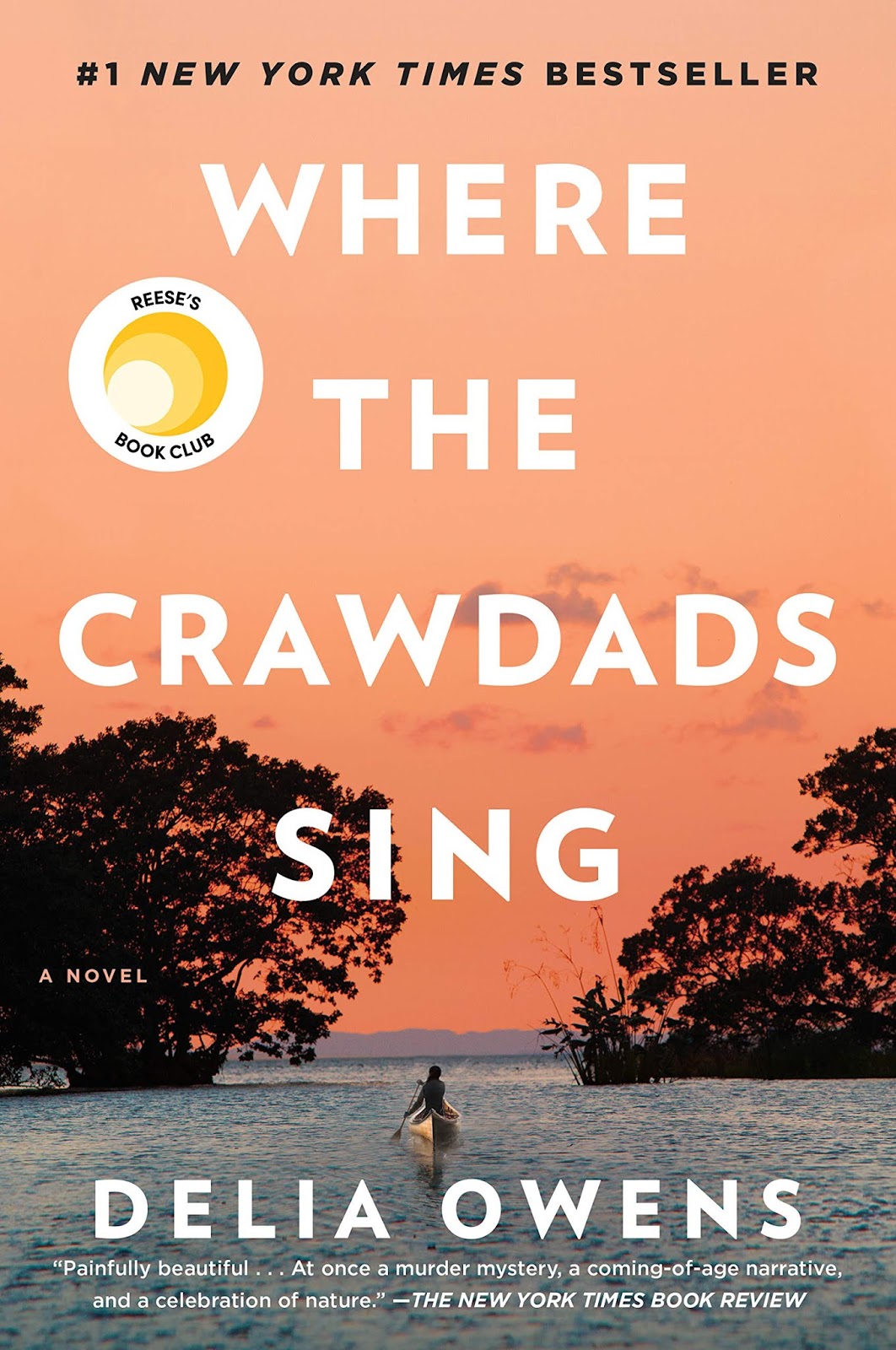
Where the Crawdads Sing by Delia Owens

It’s definitely a new favorite of mine. Most definitely. Where the Crawdad’s Sing sits on my shelf of favorite books along with The Nightingale by Kristen Hannah. In a suspenseful novel, Delia Owens weaves together a powerful story about love, abandonment, the coming-of-age, and murder. It was a book that I couldn’t put down, and I found myself crying at the end of the story. 


__________

Kya has lived in the marsh her entire life, with her three siblings, mother, and abusive father. She has grown up playing in the swamps, collecting bird feathers and a variety of other wildlife. One day, when her abusive and drunk father’s temper spins out of control, her two eldest siblings leave the shack in the marsh in search of a better life. Not long after, Kya’s mother leaves the shack as well, leaving Kya and her older brother, Jodie, alone in the shack with an alcoholic father. Kya and Jodie patiently wait for their mother to return. Jodie and Kya wait for months, but they never see their mother walking down the path towards their shack. Jodie leaves the shack later, but he doesn’t bring Kya along with him because she is merely six years old at the time. This is the first moment in which Kya experiences one of the greatest losses of her time; her family abandoning her becomes the catalyst for her growing independence and reliance upon herself.  

Kya and her father get along for a decade. She grows up under the same roof as him, but she rarely sees him. Sometimes her father will go out for days on end without returning. Kya cooks for her erratic father, learns to grocery shop, while balancing her time out in the marsh. During this time, Kya attends school for exactly one day after social workers dragged her into the classroom. Unlike the other students in the classroom, Kya has never been in school before. When she misspells the word dog, as god and is made a joke of in the class, Kya vows never to set foot in a classroom again. At the age of 15, she has not the slightest inkling of how to read and she can only do simple arithmetic that gets her through the grocery store on a budget. During this time, Kya never loses her love for exploring the marsh and collecting things she finds. 

One day, Kya is hiding in the woods when she spots a boy. For weeks they do not meet each other in person, but they play what Kya calls “The Feather Game”. On a tree stump, they each leave things for the other person to collect in secret. Finally one day, the boy catches Kya collecting the feathers and goods he has left for her on the tree stump and they meet. The boy’s name is Tate, and he’s 18 years old. Tate is entranced by Kya’s wild beauty, and when he learns of her inability to read, he makes it his mission to teach her. They bond through these reading lessons and their mutual enjoyment for exploring the marsh and collecting things from nature. Tate and Kya fall heads first into love, and when Tate has to leave for college, he promises to return. But he never does. During the same time, Kya’s father leaves her, and within a couple of months, Kya finds herself having been abandoned again by the people she loves. It is after being left by Tate that Kya discovers the only person she can rely on is herself. Through this independence and her aloofness from town, people begin to dote Kya, “The Marsh Girl”. 

About five years after Tate leaves her, Kya falls in love with another man. The story becomes complicated here when at the same time, Tate comes back for Kya. Then one day, the second man Kya falls in love with is found dead and the town begins to investigate.

_________

This story touched me in so many ways. What I admire most about the protagonist, Kya, is her independence. Kya possessed what few could ever do. She took what little she’d been given, educated herself about the swamp.  Through these heart-wrenching instances where she was abandoned, I felt torn and nuanced (if that’s an appropriate adjective!). Kya had learned to rely on herself, but this also diminished her abilities to self-advocate which retaliated against her favor. Kya was afraid to speak up for herself since she’d been taught from a young age that she was the only person she could ever rely on. Her parents had left her, as had her siblings, and even her lover had broken his promise to return. Questions arose for me. How hard is it to earn trust? How many times can others break their promises before an individual retracts from trusting others? Perhaps Kya is one who had been abandoned one too many times which affected her ability to seek aid and support from others. I also love how this book uses nature and wildlife to explain expectations for humans, as it reminds readers of how closely connected we are to the animals who may live outside our doors. Owens crafts a story in which humans and nature become one thing.


Delia Owens has fantastic writing. I mean this in the sense that not only was her plot well thought out, but her prose in itself is like poetry. Her alliteration and description vividly brought to life the world in which Kya lives, particularly the nature scenes. Where the Crawdads Sing is not a difficult book to follow, though its chapters do flip between past and present. A must read!


Thursday, December 20, 2018

When Life Gives You Lululemons by Lauren Weisberger

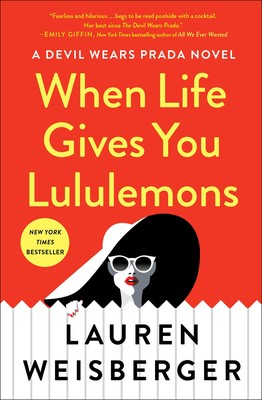
It’s the book that caught my eye at the beginning of the school year but never found the chance to pull off the shelves to read. The book’s cover is a bright shade of red with bold yellow font, but it also caught my eye because the brand of my running shorts had made it onto the cover of a New York Times Bestseller. Yes, here it is, my review on When Life Gives You Lululemons by Lauren Weisberger. 


__________

GREENWICH, CT. Karolina, a retired Polish supermodel who’s walked Victoria’s Secret seven times, is married to a US Senator (Graham). She is his second wife, and the only mother her step-son, Harry, has ever known. Graham is running for the presidency, but shortly before the election, Karolina is spontaneously arrested for driving under influence with five other children in the back of the car. She claims innocence, but the police refuse to give her a breathalyzer after finding two empty bottles of champagne in the back of the car. Not only is Karolina thrown into jail for the night, but her arrest makes the headlines and her husband’s run for presidency is affected. Karolina wants nothing more than to explain to her husband what actually happened the night of her arrest, but she finds her husband has left her and refused to let her see Harry. 

On the other coast of the States in Los Angeles, Emily Charlton is losing her clients one by one. A well-reputed image consultant, with impeccable style, a fastidious lifestyle, and a relentless concern for health and wellness, her style is apparently being doted “out of date”. Emily has directed many shows for Runway under Miranda Priestly (pretty much the Anna Wintour of When Life Gives You Lululemons), saved the images and public reputations of many superstars, and she is confident she can fix anybody’s broken image. Over 10 years of experience has confirmed this confidence. However, suddenly it seems that she is losing her biggest clients to a new image consultant in the media. For Emily, she’s looking for her next big break that will hopefully save her own image as an image consultant. 

Miriam is a retired Partner from a law firm in New York City. She moved to Greenwich recently and hopes to raise her kids better in the suburbs. Through her daily workouts at SoulCycle, morning jogs with other moms, and Books Clubs, she learns about life in Greenwich. Through talking with other women, Miriam begins to feel insecure about her own marriage. A critical character in the plot, when Miriam first hears about Karolina’s DUI, she calls her old friend and Miriam helps Karolina work through her emotions. Also a friend of Emily’s, Miriam unintentionally invites Emily to her home in Greenwich. Karolina meets Emily as a result, and the two form a friendship. Through Emily and Miriam’s support and friendship, Karolina discovers her true motive is not getting revenge on her Senator husband, but getting her son back. Emily and Miriam later help Karolina rebuild her public image in order to win back Harry.

________


When Life Gives You Lululemons is adventurous, humorous, and a good source for blowing off some steam. It reminded me of Crazy Rich Asians, but with a more clear plot and added suspense. I must admit I was a little bit disappointed with Weisberger’s writing style. Her writing was fairly easy to follow but lacked formal prose and literally depth. What I did really enjoy about this novel was experiencing the lives these women lead after growing up. It almost provided insight into adult life and the feeling of growing up, but maybe that’s just an opinion coming from a teenager. I would deem this an excellent beach book! 


Saturday, December 15, 2018

Turbulence on a tightrope

At school, all students take a Foundations course called Empathy, Balance, and Inclusion (EBI).  For many students, it’s the course that they roll their eyes at and say EBI? Not again… I’m quite surprised people dislike this course. While EBI is only three years old and still undergoing course development and refinement, I would say it’s one of my favorite 45 minutes of the week. Earlier this week, our class talked about WOOP, a strategy to tackle our goals in life, which I’ve been thinking through lately.

WOOP stands for wish, outcome, obstacle, and plan. It’s a strategy for achieving goals. What I like most about WOOP is that it not only talks about what we may have as goals, but it tells us to expect setbacks and encourages us to prepare ourselves mentally for overcoming them. Perhaps one of the biggest reasons why I set goals for myself and then fail to achieve them is because I’m not mentally prepared for a setback. I’ll often set goal x, and then go off track a little bit and struggle to restabilize myself towards that goal. For example, maybe my goal is to practice piano every day over break. Maybe I discover that I will be traveling for a little while. Coming back, it’s difficult to return to that goal-oriented mindset. Maybe my goal is to learn a section in my math book every day, but I slip one day, and then I can no longer get back into that streak. 

I’ve noticed a pattern: I have a tendency to set high goals and standards and work towards them consistently for a solid length of time. Perhaps this is what has earned me the description of “goal-oriented”. While I may be working towards a goal consistently, the entire time, it’s as if I’m walking on a tightrope. Any sort of turbulence could shake me off at any time. I need to get myself out of this tendency because I’ve realized that I’m entering this phase in my life that’s pretty critical. I’m nearing the middle of my high school career, and sooner than I can believe it, I’ll be heading right into the college application process. This is the moment in my life where consistency is critical. I cannot allow one setback, one small turbulence, or one small disturbance to utterly destroy the markers I’ve set for myself. I would like to stay on that tightrope. 

I suspect these next two years will be like a marathon, slow, steady, but consistent. It’s not a one month and done scenario. It’s a gradual build-up. It’ll be weeks filled with work, stress, and struggle, but on a more positive note, it will also be a time where I learn a lot about myself. I suspect I will learn about myself as a thinker, as a student, and as a citizen. Honestly, I’m kind of excited for that.